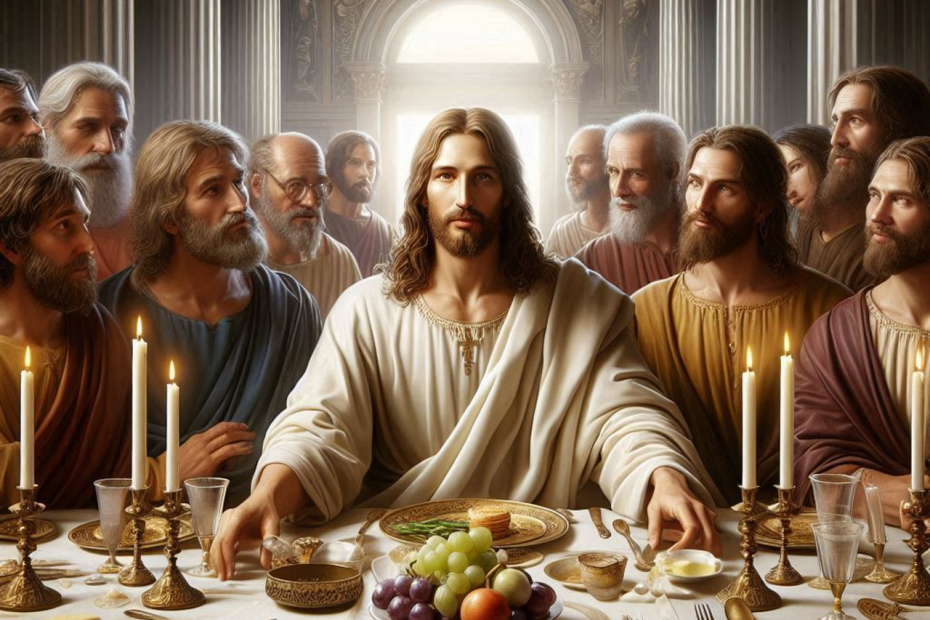
Lord’s Supper
The Lord’s Supper is for us to remember Jesus. Christians the world over partake in the Lord’s Supper which glorifies Jesus.
This is a Bible Study. Have your own Bible handy to look up the references mentioned.
If you do not have a Bible, I invite you to go to BibleGateway.com or another online Bible.
1.Refer to the end of the discussion on chapter 10 for verse 1.
2. Paul “praises them because they have remembered him in prayer and in their giving, and they were practicing the ordinances he had taught them.” (McGee, J. Vernon, Thru the Bible: Volume V. [Nashville: Thomas Nelson, 1983], 49)
3. “The Christian faith brought freedom and hope to women, children, and slaves. It taught that all people, regardless of race or sex, were equal before their Creator, and that all believers were one in Jesus Christ (Gal. 3:28).” (Wiersbe, Warren W, The Bible Exposition Commentary New Testament Volume 2. [Colorado Springs: David C Cook, 1989], 603)
4. “This refers to an experience Moses had when he came down from the mount where he had communed with God. When he first came down, the skin of his face shone, but after a while that glory began to disappear (Exod. 34:33-35.” (McGee, 50)
5. “Paul says the man should have his head uncovered but the woman should have her head covered. I want you to note that it says ‘every woman that prayeth or prophesieth,’ which means that a woman can pray in public and means she can speak in public.” (McGee, 50)
6. “The unveiled woman in Corinth was a prostitute. Many of them had their heads saved. The women who had their heads uncovered were the prostitutes.” (McGee, 50)
Image of God
7. “According to Genesis 2:18,20, God created Eve to make it possible for the human race to fulfill the task originally given to Adam. For this reason Moses called Eve ‘a helper suitable for [Adam].’” [Max Anders and Richard Pratt (2012). HNTC Vol. 07: I & II Corinthians. B&H Publishing Group. Retrieved from https://read.lifeway.com]
8a. “God’s order is based on the fact that man was created first (1 Tim. 2:13), and that the woman was created for the man.” (Wiersbe, 604)
8b. “Again, priority does not imply inferiority; for Paul made it clear in 1 Corinthians 11:11-12 that there is partnership as well as headship in God’s creation.” (Wiersbe, 604)
9. “The woman was created for the man’s sake (Gn 2:18), to come to his aid, not vice versa, suggesting also the priority of male leadership.” (Moody, 1791)
10. “In some special way, the angels share in the public worship of the church and learn from the church (Eph. 3:10; 1 Peter 1:12).” (Wiersbe, 604)
11-12. “Women need the men in the church, and men need the women. This is in keeping with the divine design of the human race by the Lord (Jesus, v. 11) and by God (v. 12).” (Moody, 1791)
You Judge
13. “Paul put the matter to them plainly, asking if it were proper for women to pray in public worship with their heads uncovered. By stating the question in terms of propriety, Paul avoided speaking directly of sin.” [Max Anders and Richard Pratt (2012). HNTC Vol. 07: I & II Corinthians. B&H Publishing Group. Retrieved from https://read.lifeway.com]
14. “It was a dishonor for a man to have long hair in first-century Corinth.” (Moody, 1791)
15. “Paul expected the Corinthians to recognize that men should have short hair and women long hair. He also expected them to see that the glory of women’s long hair implied the propriety of women’s head coverings in worship.” [Max Anders and Richard Pratt (2012). HNTC Vol. 07: I & II Corinthians. B&H Publishing Group. Retrieved from https://read.lifeway.com]
16. “Paul concludes by saying that the church ought not to make rules in connection with the matter of women’s dress or men’s hair. The really important issue is the inner man.” (McGee, 62)
Lord’s Supper
17. “The Corinthians may have called their fellowship meals ‘the Lord’s Supper,’ but Paul could not praise them since their gatherings failed to demonstrate the most basic understanding of the significance of the meal.” (Taylor, 268)
18. “The report of divisions recalls the report from Chole’s household mentioned at the beginning of the letter (cf. 1:10-17).” (Taylor, 268)
19. “Factions means ‘the dividing of people into opposing groups.’ These problems with unity arose in God’s providence so that the church could recognize the believers who promoted concord and who were thus worth following.” (Moody, 1792)
20. “It is impossible for this to celebrate the Lord’s Supper because of the way that they conducted the feast which preceded it. Under such circumstances they couldn’t celebrate the Lord’s Supper.” (McGee, 54)
21. “Another fault was selfishness: the rich people brought a great deal of food for themselves, while the poor members went hungry. The original idea of the agape feast was sharing, but the idea had been lost.” (Wiersbe, 604)
22. “A potluck associated with communion was not the place for glutton, and the thoughtlessness exhibited against the poor was inexcusable.” (Moody, 1792)
23-26. “The broken bread reminds us of Christ’s body, given for us; and the cup reminds us of this shed blood. It is a remarkable thing that Jesus wants us to remember His death…Why? Because everything we have as Christians centers in that death.” (Wiersbe, 605)
Examine Yourself
27. “To sin against the body and blood is to sin against the very hope of salvation. They also sinned against the body and blood of the Lord by sinning against Christ’s church, or more particularly against the poor Christians who were not granted admission to the Lord’s Supper.” [Max Anders and Richard Pratt (2012). HNTC Vol. 07: I & II Corinthians. B&H Publishing Group. Retrieved from https://read.lifeway.com]
“Paul did not say that we had to be worthy to partake of the Supper, but only that we should partake in a worthy manner.” (Wiersbe, 605)
28. “In order not to partake unworthily, one must examine himself to determine if he is entering communion with the proper focus and attention.” (Moody, 1792)
29a. “For (v. 29) strengthens Paul’s admonition in v. 28 about self-examination.” (Moody, 1792)
29b. “Judgment does not refer to eternal condemnation, for it is unlikely that Paul would understand that a blood-bought believer who inappropriately participated in communion would face eternal condemnation.” (Moody, 1793)
Unworthy
30. “They suffered sickness and death. Why? Because they had participated in the Lord’s Supper unworthily—that is, in an unworthy manner.” (McGee, 56)
31-32. “This is talking about believers. We can judge ourselves when we are wrong. If we don’t, He will judge us. When we are judged of the Lord, we are chastened so that we shall not be condemned with the world.” (McGee, 56)
33. “They needed to wait for each other. Instead of the rich eating first and the poor not eating at all, all participants in the feast were to eat at the same time. This would show proper honor to the poor, and thereby to Christ.” [Max Anders and Richard Pratt (2012). HNTC Vol. 07: I & II Corinthians. B&H Publishing Group. Retrieved from https://read.lifeway.com]
34. “He did not chide the poor for coming to the Lord’s Supper hungry— they could not avoid it. Those of means who were hungry were to eat at home so there would be enough food for the poor.” [Max Anders and Richard Pratt (2012). HNTC Vol. 07: I & II Corinthians. B&H Publishing Group. Retrieved from https://read.lifeway.com]
References
Holman Christian Standard Bible (HCSB)
Copyright © 1999, 2000, 2002, 2003, 2009 by Holman Bible Publishers, Nashville Tennessee. All rights reserved.
New American Standard Bible (NASB)
New American Standard Bible®, Copyright © 1960, 1971, 1977, 1995, 2020 by The Lockman Foundation. All rights reserved.
New King James Version (NKJV)
Scripture taken from the New King James Version®. Copyright © 1982 by Thomas Nelson. Used by permission. All rights reserved.
In this article Scripture quotations taken from KJV.
McGee, J. Vernon, Thru the Bible: Volume V. Nashville: Thomas Nelson, 1983
Max Anders and Richard Pratt (2012). HNTC Vol. 07: I & II Corinthians. B&H Publishing Group. Retrieved from https://read.lifeway.com
The Moody Bible Commentary, The Moody Bible Institute of Chicago, Moody Publishers, Chicago, IL, 2014
Taylor, Mark, The New American Commentary Volume 28, 1 Corinthians. Broadman Press, 1996
Wiersbe, Warren W, The Bible Exposition Commentary New Testament Volume 2. Colorado Springs: David C Cook, 1989
