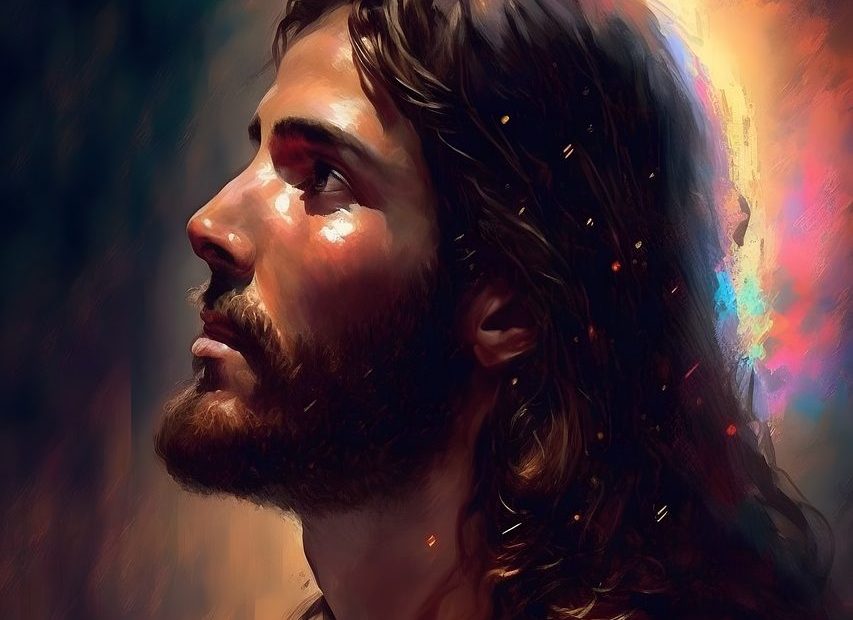
Son
Jesus the Son of God came to the earth to give each of us a way to God. Jesus died on a cross for each of us. Are you willing to follow Jesus?
This is a Bible Study. Have your own Bible handy to look up the references mentioned.
If you do not have a Bible, I invite you to go to BibleGateway.com or another online Bible.
1. “Among the blessings of the Christian experience is adoption (Gal. 4:5; Eph. 1:5).…The only way to get into God’s family is by regeneration, being ‘born again’ (John 3:3).” (Wiersbe, Warren W, The Bible Exposition Commentary New Testament Volume 1. [Colorado Springs: David C Cook, 1989], 705)
2. This refers to “the time when the father recognized that his son was capable of making decisions of his own, and he brought him into the position of a full-grown son.” (McGee, J. Vernon, Thru the Bible: Volume V. [Nashville: Thomas Nelson, 1983], 175)
3. “When a sinner trusts Christ and is saved, as far as his condition is concerned, he is a ‘spiritual babe’ who needs to grow (1 Peter 2:2-3).” (Wiersbe, 705)
4. “The phrase When the fullness of time came does not speak of human events that constrained God.…The time’s completion was brought about the coming of the Son.” (The Moody Bible Commentary, The Moody Bible Institute of Chicago, [Moody Publishers, Chicago, IL, 2014], 1836)
5. Jesus “took on him not only the calling of a man, but our responsibility as sinful men; it is in this word as our Redeemer lies, for it is in this that the measure, or rather the immensity, of his love is seen.” (George, Timothy. The New American Commentary, Galatians. [© Copyright 1994, Broadman Holman Publishers], 304)
Sons
6. “God the Father sent the Son to die for us, and God the Son sent His Spirit to live in us. The contrast here is not between immature children and adult sons, but between servants and sons.” (Wiersbe, 706)
7. “The Spirit, therefore, gives us an experience of being a son of God, whereby we can cry out—not just saying the word or putting on a false ‘piosity’—and call God our Father, because the Spirit is bearing witness with our spirit.” (McGee, 177)
Concern
8. “Coming to know God is the language of conversion (Jn 17:3); did not know God is said of the unconverted or pagans (Jr 5:4; 1 Th 4:5). (Moody, 1836)
9. “When they were ignorant sinners, they had served their false gods and had experienced the tragedy of such pagan slavery. But then they had trusted Christ and been delivered from superstition and slavery.” (Wiersbe, 707)
10. “A religion of ‘days, months, seasons, and years’ can never lead to liberation from the weak and beggarly elemental spirits whose grasp can only be escaped through faith in the one who came ‘in the fullness of time.’” (George, 3180
11. “Paul did not hint at loss of salvation. The question is whether his initial work (labor) resulted in their coming to true saving faith at all.” (Moody, 1836)
Personal
12. “Christ has delivered me from bondage to the law. I now live by faith in him who loved me and gave himself for me (Gal 2:20).” (George, 321)
13. What the illness was is unknown. George suggested “the idea that Paul was referring here to some actual bodily illness that affected his missionary labors.” (322)
14. “Whatever the nature of Paul’s physical affliction, it must have resulted in some kind of bodily disfigurement or obviously unpleasant symptoms so that his condition was a ‘trial’ to the Galatians.” (George, 324)
15. “It must have made Paul somewhat repulsive in appearance, because he commended the Galatians for the way they received him in spite of the way he looked.” (Wiersbe, 708)
16. “Many folk today really don’t want the preacher to tell the truth from the pulpit. They would much rather he would say something complimentary that would smooth their feathers and make them feel good.” (McGee, 179)
17. “Paul contrasted his motivations with those of the legalists. They sought the Galatians falsely to cut them off from Paul and his gospel.” (Moody, 1837)
18. “Paul sought the Galatians for this good (in a commendable way) both in this letter and when he was present with them.” (Moody, 1837)
19. Paul “was deeply anguished over the Galatians. He did not want them to suffer a spiritual miscarriage but desired instead that they make their calling and election sure.” (George, 330)
20. ‘Being present with them would grant first-hand information and more time; he could speak with them and not just to them.” (Moody,1837)
Hagar and Sarah
21. “Here another kind of bondage, or better, another form of the same bondage is in view, that which results from being ‘under the law.’” (George, 334)
22. “Using an illustration from the life of Abraham (Gen. 16; 17; 20; 21), Paul is going to make a contrast between these two boys that were born, one to Hagar and one to Sarai.” (McGee, 181)
23. “Paul reminded readers of basic facts from Genesis: Hagar was a slave; Sarah was free. Ishmael was born through normal human action (flesh); but Isaac was born by God’s action (promise).” (Moody, 1837)
24-25. “Paul began with two sons, Ishmael and Isaac, and explained that they illustrate our two births; the physical birth that makes us sinners and the spiritual birth that makes us the children of God.” (Wiersbe, 709)
26. “‘Jerusalem which is above’ is the New Jerusalem which is presented to us in the twentieth chapter of Revelation as it comes down from God out of heaven. As old Jerusalem is the mother of those under the law, so the New Jerusalem is the mother city of the believer under grace.” (McGee, 181)
27. “The great reversal envisioned by Isaiah—from barrenness to fruitfulness, from despair to joy, from desolation to blessing—can only be accomplished by the unilateral intervention of God himself.” (George, 345)
Promise
28. “Believers today are also children of promise. Our birth is a new birth, which comes about by our believing God’s promise (John 3:16).” (McGee, 181)
29. Paul “clearly saw a corresponding historical parallel between the mistreatment of Isaac by Ishmael and the persecution being inflicted on Christians of his day.” (George, 346)
30. “‘Cast out the slave woman and her son!’ Paul was calling on his erstwhile disciples to free themselves from the grip of the Judaizers and to expel them from their midst.” (George, 347)
31. “Paul is saying that you can’t be saved by law and grace. You have to make a choice. If you try to be saved by Christ and also by law, you are not saved.” (McGee, 182)
“We must keep in mind that legalism does not mean the setting of spiritual standards; it means worshipping these standards and thinking that we are spiritual because we obey them.” (Wiersbe, 712)
References
Holman Christian Standard Bible (HCSB)
Copyright © 1999, 2000, 2002, 2003, 2009 by Holman Bible Publishers, Nashville Tennessee. All rights reserved.
New American Standard Bible (NASB)
New American Standard Bible®, Copyright © 1960, 1971, 1977, 1995, 2020 by The Lockman Foundation. All rights reserved.
New King James Version (NKJV)
Scripture taken from the New King James Version®. Copyright © 1982 by Thomas Nelson. Used by permission. All rights reserved.
In this article Scripture quotations taken from KJV.
George, Timothy. The New American Commentary, Galatians. © Copyright 1994, Broadman Holman Publishers
McGee, J. Vernon, Thru the Bible: Volume V. Nashville: Thomas Nelson, 1983
The Moody Bible Commentary, The Moody Bible Institute of Chicago, Moody Publishers, Chicago, IL, 2014
Wiersbe, Warren W, The Bible Exposition Commentary New Testament Volume 1. Colorado Springs: David C Cook, 1989
