Philip
Acts 8 discusses Saul, Philip, Simon, and an Ethiopian treasurer. Each had different experience, but each spread the gospel wherever they went.
This is a Bible Study. Have your own Bible handy to look up the references mentioned.
If you do not have a Bible, I invite you to go to BibleGateway.com or another online Bible.
Saul
1. “Stephen’s speech enraged his hearers because it challenged the central tenets of first-century Judaism, it identified a Messiah rejected by the Sanhedrin, it threatened the authority of Judaism’s leadership.” (The Moody Bible Commentary, The Moody Bible Institute of Chicago, [Moody Publishers, Chicago, IL, 2014], 1689)
“Luke introduced Saul for the first time at the stoning of Stephen. He was the young man who watched over the garments of the witnesses as they stoned Stephen (Acts 7:58).” (Polhill, John B., The New American Commentary, Volume 26, Acts, [ © Copyright 1992, Broadman Press], 210)
Persecution has started!
2. Stephen was taken “up gently and put him in the ground as you would plant a seed. His body went into the ground to await the resurrection.” (McGee, J. Vernon, Thru the Bible: Volume V. [Nashville: Thomas Nelson, 1983], 542)
3. “Saul led the charge in the streets, house to house, men and women. He did not just arrest Christians; he dragged them off.” [Max Anders and Kenneth O. Gangel (2012). HNTC Vol. 05: Acts. B&H Publishing Group. Retrieved from https://read.lifeway.com]
Philip
4.” “Persecution does to the church what wind does to seed: it scatters it and only produces a greater harvest.…The believers in Jerusalem were God’s seed, and the persecution was used of God to plant them in new soil so they could bear fruit (Matt. 13:37-38).” (Wiersbe, 434)
5. “Philip did not change the message for the Samaritans, and he appealed for them to become followers of Jesus, not to convert to Judaism.” (Moody, 1690).” (Moody, 1690)
6. “Philip’s preaching, like that of the Jerusalem apostles, was undergirded by ‘signs,’ miracles that pointed beyond themselves to the power and life to be found in the one he proclaimed.” (Polhill, 215)
7. “Demons were exorcised. Paralytics and lame persons were healed.” (Polhill, 215)
8. That brought joy to the people.
Simon
9. “Now a shadowy figure appears on the scene. There was a man named Simon, who had been practicing magic among the Samaritans and for a long time had astounded them with his tricks.” (Polhill, 215)
10. “Luke clearly depicted Simon as a worker of magic, a charlatan who made money from his bag of tricks.” (Polhill, 215)
11. “These people felt that Simon the sorcerer was like a god.…Even if a man is giving out the Word of God, do not look to the man. Look to the Word of God and check to see if he is presenting it accurately.” (McGee, 543)
12-13. “What does it mean that ‘Simon himself believed’? …His faith was not in the Word of God, but in the miracles he saw Philip perform, and there is no indication that Simon repented of his sins. He certainly did not believe with all his heart (Acts 8:37).” (Wiersbe, 435)
14. “When the church in Jerusalem heard of the response of the Samaritans to the word of God, they send Peter and John to investigate.” (Moody, 1690)
15-17. “Peter and John discovered that, though many Samaritans had believed, they had not received the Spirit.…The Samaritans received the promised Spirit at the hand of the apostles subsequent to Philip’s evangelizing and their trusting in Christ for salvation.” (Moody, 1691)
18-19. “Simon wanted to pay for the gift. Why? Well, because this man is a religious racketeer. He wants to use it for profit.” (McGee, 544)
Perish
20. “The true heart of Simon begins to emerge. Whatever he believed back in verse 13, it was certainly not faith for salvation, else Peter could never have said he would perish.” [Max Anders and Kenneth O. Gangel (2012). HNTC Vol. 05: Acts. B&H Publishing Group. Retrieved from https://read.lifeway.com]
21-23. “Simon had not responded to the gospel; he had responded to greed. He lacked the contrition and inner conviction that accompany a true response to the gospel. His heart was ‘not right before God.’” (Polhill, 220)
24. “The question is whether Simon did in fact repent. His response may express a degree of remorse but scarcely the sort of complete turnabout of will and mind that marks true repentance. In fact, Simon expressed no repentance.” (Polhill, 220)
25. “Peter and John returned to Jerusalem, preaching the gospel in ‘many villages of the Samaritans’ as they went their way. They lost no opportunity to share the good news with others now that the doors were open in Samaria.” (Wiersbe, 436)
Philip
26. “Empowered by the Holy Spirit, this lay evangelist went wherever God sent. Philip was on his way to the end of the Palestinian world of that time. South and west of Gaza the desert trailed off across Sinai into Egypt.” [Max Anders and Kenneth O. Gangel (2012). HNTC Vol. 05: Acts. B&H Publishing Group. Retrieved from https://read.lifeway.com]
27. “This Ethiopian represents many people today who are religious, read the Scriptures, and seek the truth, yet do not have saving faith in Jesus Christ.” (Wiersbe, 437)
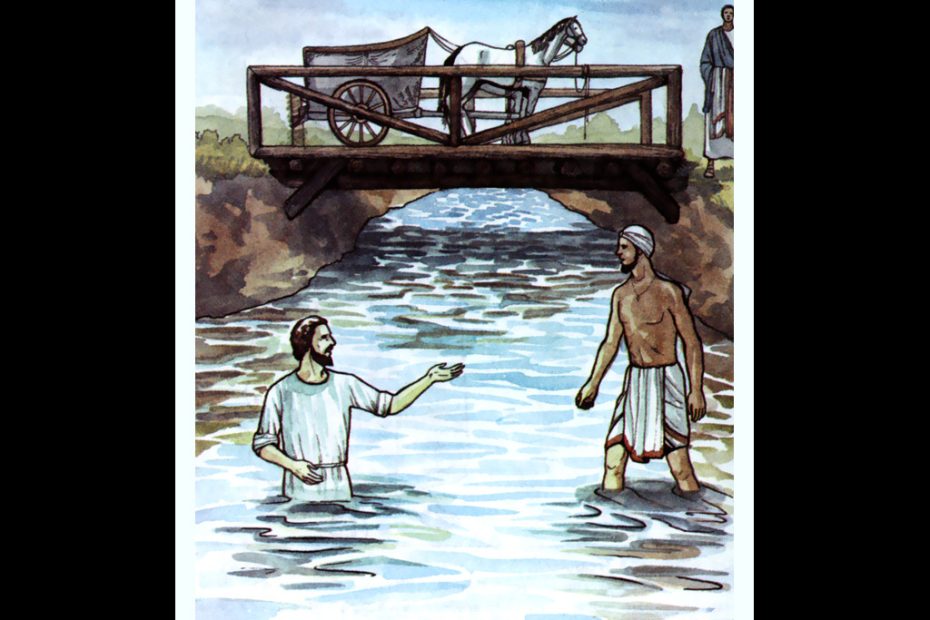
28. “Probably not by accident, the eunuch was reading from a scroll of the prophet Isaiah as his carriage lumbered slowly homeward. (v. 28). “(Polhill, 224)
29. “Philip had to be prodded by the Spirit: ‘Go to that chariot and stay near it.’ Philip had no idea what he should do. The Spirit assumed the lead all the way.” (Polhill, 224)
Chariot
30. “As Philip drew near to the chariot, he heard the man reading from the prophet Isaiah.…God had already prepared the man’s heart to receive Philip’s witness! If we obey the Lord’s leading, we can be sure that God will go before us and open the way for our witness.” (Wiersbe, 437)
31. “Philip discovered he was reading from the prophet Isaiah but did not understand the passage. He became the official’s guide for interpreting Isaiah.” (Moody, 1691)
32. “The passage is from Is 53:7-8, which compares the Suffering Servant to a sacrificial lamb, whose life was taken from him in unjust judgment.” (Moody, 1691)
33. “Philip explained the passage is about Jesus, and focused witness on the person of Christ.” (Moody 1691)
34-35. “Not only did the eunuch invite Philip to sit with him and explain the text, but he asked the very questions that lead to an introduction of the Savior.” [Max Anders and Kenneth O. Gangel (2012). HNTC Vol. 05: Acts. B&H Publishing Group. Retrieved from https://read.lifeway.com]
36. “The wagon passed a pool of water, and the Ethiopian was ready.” (Polhill, 225)
See, here is water; what doth hinder me to be baptized? [V36 KJV]
37. “When this man asks for water baptism, Philip wants to be very sure that he believes with all his heart.” (McGee, 547)
38. This “relates the Baptist of the Ethiopian treasurer.” (Polhill, 226)
39. “When the two emerged from the water, they departed in opposite directions.” (Polhill, 227)
40. “Azotus is Ashdod, which is over in the Gaza strip.” (McGee, 547)
References
Holman Christian Standard Bible (HCSB)
Copyright © 1999, 2000, 2002, 2003, 2009 by Holman Bible Publishers, Nashville Tennessee. All rights reserved.
New American Standard Bible (NASB)
New American Standard Bible®, Copyright © 1960, 1971, 1977, 1995, 2020 by The Lockman Foundation. All rights reserved.
New King James Version (NKJV)
Scripture taken from the New King James Version®. Copyright © 1982 by Thomas Nelson. Used by permission. All rights reserved.
In this article Scripture quotations taken from KJV.
McGee, J. Vernon, Thru the Bible: Volume V. Nashville: Thomas Nelson, 1983
The Moody Bible Commentary, The Moody Bible Institute of Chicago, Moody Publishers, Chicago, IL, 2014
Polhill, John B., The New American Commentary, Volume 26, Acts, © Copyright 1992, Broadman Press
Wiersbe, Warren W, The Bible Exposition Commentary New Testament Volume 2. Colorado Springs: David C Cook, 1989
