Ephesus
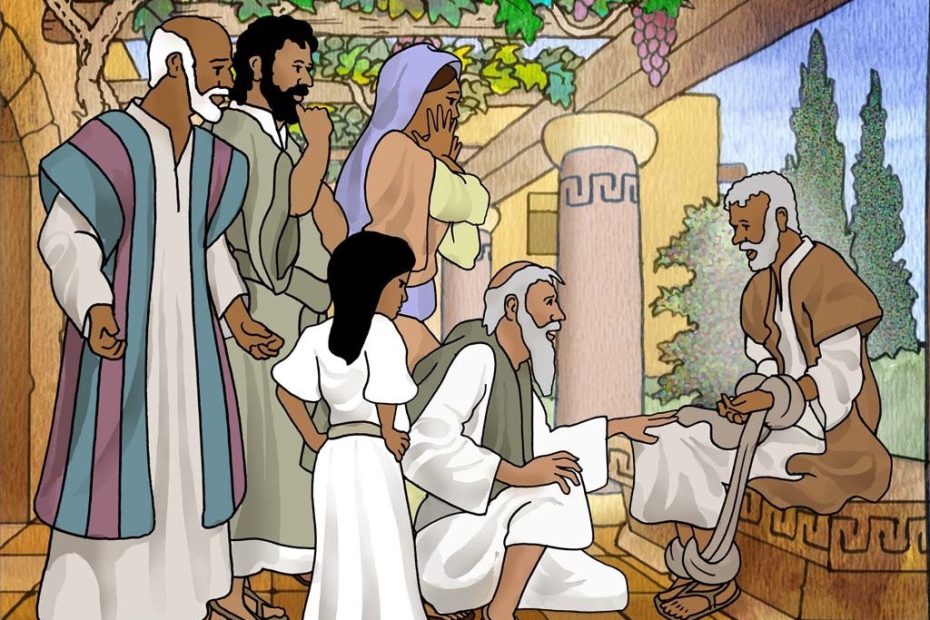
Paul went to Ephesus and told people there about Jesus. He was able to convert some people but before he left the silversmiths caused a riot.
This is a Bible Study. Have your own Bible handy to look up the references mentioned.
If you do not have a Bible, I invite you to go to BibleGateway.com or another online Bible.
1-3. “When Paul arrived at Ephesus, he encountered ‘some disciples.’…Evidently they were not at this point strictly Christian disciples but rather disciples of John the Baptist.” (Polhill, John B., The New American Commentary, Volume 26, Acts, [© Copyright 1992, Broadman Press], 398)
4. “To be a true disciple of John was to confess Jesus…They failed to recognize Jesus as the one whom John had proclaimed, as the promised Messiah.” (Polhill, 399)
5. “The baptism of John was a ‘baptism of repentance.’ It was a preparation for the coming of the Lord Jesus Christ. Now the people turn to Christ and are saved.” (McGee, J. Vernon, Thru the Bible: Volume V. [Nashville: Thomas Nelson, 1983], 597)
6-7. “These men could now speak the gospel in other languages—in tongues that could be understood.…There were many languages spoken there.…Notice there were twelve men. This was the beginning of the ministry at Ephesus.” (McGee, 597)
The Way
8. Paul “attempted to persuade the Jewish people about the kingdom of God for three months.” (The Moody Bible Commentary, The Moody Bible Institute of Chicago, [Moody Publishers, Chicago, IL, 2014], 1718)
9. “This group of people was resistant to the gospel. They maligned Paul’s message, speaking evil of the Way. The word Way describes the new way of following Jesus for Jewish people and the world.” (Moody, 1718)
10. “Our author intends to demonstrate that the evangelism at Ephesus spread much wider than the city itself. During this time the missionary team founded churches in Colosse, Laodicea, and Hierapolis, commonly known as the churches of the Lycus Valley.” [Max Anders and Kenneth O. Gangel (2012). HNTC Vol. 05: Acts. B&H Publishing Group. Retrieved from https://read.lifeway.com]
11. “The Lord confirmed Paul’s ministry by empowering him to work extraordinary miracles. By using extraordinary to describe Paul’s miracles Luke implied that they were exceptional in comparison even to the other miracles recorded in Acts.” (Moody, 1718)
12. “The people believed that even the cloths that had touched the apostle’s body had healing efficacy, and Luke indicated that such was indeed the case.” (Polhill, 401)
Exorcists
13. “When they saw what Paul did, they tried to duplicate it.” (McGee, 598)
14. “Notice that these were priests. The priests had actually gone into this type of thing.” (McGee, 598)
15. “So often with the exorcisms performed by Jesus, the demon confessed Jesus and even acknowledged that the power of Jesus worked through Paul.” (Polhill, 404)
16. “The incident contrasted Paul’s power and apostleship with the impotent attempt of Jewish magicians to exploit the power of the resurrected Jesus.” (Moody, 1718)
17. “A reverent fear seized them, and they magnified the name of the Lord Jesus.” (Polhill, 405)
18. There “were Christians who had delved in the magical arts before their conversion who now came and openly confessed their former deeds.” (Polhill, 405)
19. “Some did become believers, and they gave tangible evidence of their faith by burning their books on magic.” (Moody, 1719)
20. “God’s power at work in Paul to produce miracles was genuine. It was for the purpose of promoting the Word of God and not for financial gain to fund an extravagant lifestyle.” (Moody, 1719)
Artemis
21. “We have the first mention of Paul’s plan to visit Rome. The fulfilling of this plan will be described in the last third of the book of Acts.” (Wiersbe, 482)
22. “Paul sent two of his coworkers ahead intro Macedonia to prepare for his own coming.” (Polhill, 407)
23. “Christianity had no name for the churches at that time—certainly no denominational name. It was simply called ‘that way.’” (McGee, 599)
Opposition
24. “Demetrius, who may have been a leader of the silversmiths, organized a protest. He and the other silversmiths made their living by selling small silver images of the temple of Artemis to pagan images.” (Moody, 1719)
25. “Christianity was a threat to their livelihood. Their income depended on selling idols.” (Moody, 1720)
26. “This man Paul had persuaded many, not only in Ephesus but also in all of Asia, that man-made gods were not gods at all.” (Moody, 1720)
27. “Not only was his preaching endangering the income of the silversmiths, but also Artemis might be dethroned.” (Moody, 1720)
28. “Demetrius’s appeal had the desired effect, with all the craftsmen running forth and shouting, ‘Great is Artemis of the Ephesians!’” (Polhill, 411)
29. “The mob rushed into the theater, the largest public building in Ephesus. It was an open-air amphitheater, 495 feet in diameter, built onto the western slope of Mt. Pion. Its seating has been estimated at 24,500.” (Polhill, 411)
30-31. “Unconcerned about his safety Paul wanted to address the mob, but he was restrained by his disciples, and some of the Asiarchs.” (Moody, 1720)
32-33. “The majority had merely succumbed to mob mentality and did not know what was going on. The scene with Alexander the Jew only added to the confusion.” (Polhill, 412)
34. “Alexander had no opportunity to speak. His voice was drowned out by the din of the incessant chant ‘Great is Artemis of the Ephesians.’ This went on for two hours. Only the city clerk prevented the rally from developing into a full riot.” (Polhill, 412)
Town clerk
35-36. The town clerk “had no difficulty quieting the commotion.…His main concern was that the disturbance would make an adverse impression on the Roman officials, possibly leading to restriction on their self-governing privileges.” (Polhill, 412)
37-38. “Luke records the official statement that the believers were innocent of any crime, either public or private.” (Wiersbe, 483)
“He is saying that if the silversmiths want to make a legal charge, the court is open.” (McGee, 600)
39. “He told them that if they had some issue to bring up, they should all sit down and have an orderly meeting. They were to put down their placards and quit their shouting and running around.” (McGee, 600)
40. “They were actually in danger of being accused of rioting.” (McGee, 601)
41. “When he called their attention to what they were actually doing, the crowd broke up and the people went home. Paul’s ministry in Ephesus is over now. He leaves Ephesus and goes back to Macedonia.” (McGee, 601)
References
Holman Christian Standard Bible (HCSB)
Copyright © 1999, 2000, 2002, 2003, 2009 by Holman Bible Publishers, Nashville Tennessee. All rights reserved.
New American Standard Bible (NASB)
New American Standard Bible®, Copyright © 1960, 1971, 1977, 1995, 2020 by The Lockman Foundation. All rights reserved.
New King James Version (NKJV)
Scripture taken from the New King James Version®. Copyright © 1982 by Thomas Nelson. Used by permission. All rights reserved.
In this article Scripture quotations taken from KJV.
McGee, J. Vernon, Thru the Bible: Volume V. Nashville: Thomas Nelson, 1983
The Moody Bible Commentary, The Moody Bible Institute of Chicago, Moody Publishers, Chicago, IL, 2014
Polhill, John B., The New American Commentary, Volume 26, Acts, © Copyright 1992, Broadman Press
Wiersbe, Warren W, The Bible Exposition Commentary New Testament Volume 2. Colorado Springs: David C Cook, 1989
