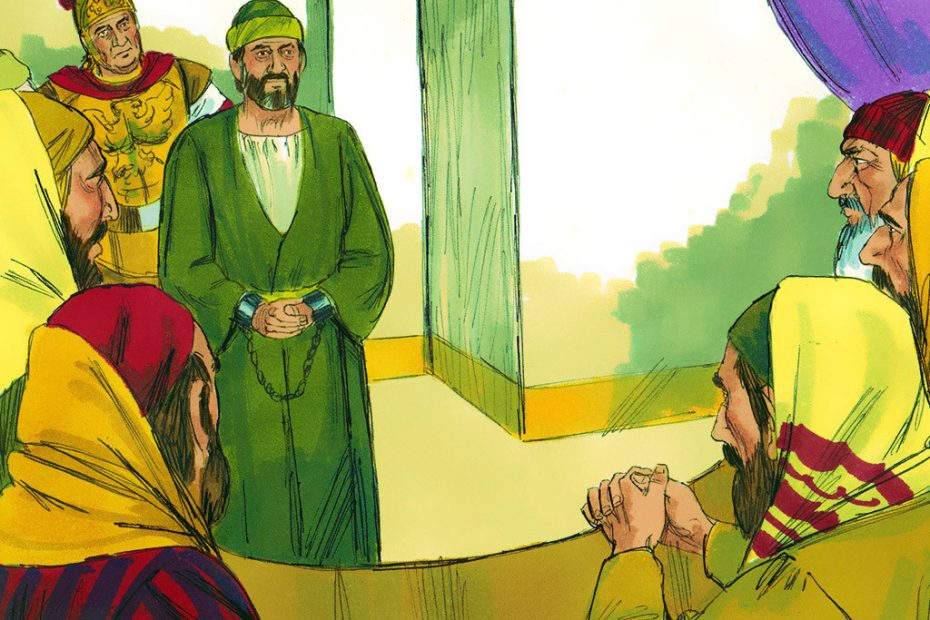
Jerusalem
While on the way to Jerusalem, Paul received at least one warning about being put in prison.
This is a Bible Study. Have your own Bible handy to look up the references mentioned.
If you do not have a Bible, I invite you to go to BibleGateway.com or another online Bible.
Introduction
“The most striking characteristic of this section is the warning from Paul’s fellow Christians of the dangers that awaited him in Jerusalem.” (Polhill, John B., The New American Commentary, Volume 26, Acts, [© Copyright 1992, Broadman Press], 431)
1-3. “They sailed along the coast, stopping at Cos, Rhodes, and Patara. At Patara, Paul and his companions transferred to a larger ship that was sailing from Phoenicia.” (The Moody Bible Commentary, The Moody Bible Institute of Chicago, [Moody Publishers, Chicago, IL, 2014], 1724)
4. “Paul and his companions went ashore and spent seven days at Tyre. Through the Spirit the disciples warned Paul not to go to Jerusalem.” (Moody, 1724)
5. “Paul and the people with him kneeled down there on the shore.” (McGee, J. Vernon, Thru the Bible: Volume V. [Nashville: Thomas Nelson, 1983], 606)
6. “Paul continued his journey to Jerusalem.” (Moody, 1724)
Caesarea
7. “On the trip to Caesarea, Paul stopped for a day at Ptolemais and greeted the believers.” (Moody, 1724)
8. “Paul stayed with Philip the evangelist and one of the seven chosen to supervise the distribution of food to the Hellenistic widows (cf. 6:1-7).” (Moody, 1725)
9. “Luke mentioned without comment that Philip had four virgin daughters who prophesy. His intention was perhaps to confirm that the gift of the Spirit had been given to both Jews and Gentiles and to men and women.” (Moody, 1725)
10. “While Paul rested in Caesarea, the prophet Agabus came to give him a second warning message from the Lord.” (Wiersbe, Warren W, The Bible Exposition Commentary New Testament Volume 2. [Colorado Springs: David C Cook, 1989], 489)
11. “Agabus delivered his message in a dramatic way as he bound his own hands and feet with Paul’s girdle and told the apostle that he would be bound in Jerusalem.” (Wiersbe, 489)
12. “As did the saints in Tyre, so the believers in Caesarea begged Paul not to go to Jerusalem.” (Wiersbe, 489)
13. “Paul is not only willing to die for Jesus in Jerusalem. He asks the believers not to cry and break his heart.” (McGee, 607)
14. “The believers’ words echo the sincere prayer of Jesus in the garden (Luke 22:42), as they commit it to the Lord.” [Max Anders and Kenneth O. Gangel (2012). HNTC Vol. 05: Acts. B&H Publishing Group. Retrieved from https://read.lifeway.com]
Jerusalem
15. “A company of believers left Caesarea and traveled with Paul to Jerusalem, probably to celebrate the feast. It was a journey of sixty-five miles that took at least three days by foot—two days if they had animals.” (Wiersbe, 490)
16. “Once in Jerusalem, the Caesareans led them to the home of a disciple named Mnason with whom arrangements had been made for their lodging.…Paul’s third missionary journey was complete.” (Polhill, 437)
17. “Notice that when the apostle Paul came to Jerusalem, the church there received him gladly.” (McGee, 607)
18. “There were reservations, however, and these quickly unfolded the next day when Paul and his traveling companions reported to the elders of the Jerusalem church.” (Polhill, 446)
19. Paul told the elders how God had used him to explain to the Gentiles.
20. “The elders ‘praised God’ for the fruits of Paul’s work among the Gentiles.” (Polhill, 446)
Vow
21. “Jews from the Diaspora likely were the ones who spread the reports among the Jerusalem Christians was inciting Jews to abandon their ancestral customs.” (Polhill, 447)
22-23. “In order to dispel doubts, the elders suggested that Paul participate in a Nazirite vow (Nm 6:1-21) to show his respect for the law.” (Moody, 1726)
24. “He was asked to purify himself in addition to paying the expenses for the required offerings for the four men who were completing the vow.” (Moody, 1726)
25. “The words in v. 25 are to be seen as an assurance to Paul that the basic decision of the Jerusalem Conference had not been changed.” (Polhill, 449)
26. “Apparently without protest, Paul went along with the plan, symbolically identifying with the Jews in carrying out this act of piety. The plan didn’t work of course, leaving us to decide whether the vow was a good idea or not.” [Max Anders and Kenneth O. Gangel (2012). HNTC Vol. 05: Acts. B&H Publishing Group. Retrieved from https://read.lifeway.com]
Riot
27-28. “The public relations strategy backfired. Asian Jews (most likely from Ephesus) saw another chance to get at Paul in an environment more conducive to their criticism than was their home city.” [Max Anders and Kenneth O. Gangel (2012). HNTC Vol. 05: Acts. B&H Publishing Group. Retrieved from https://read.lifeway.com]
29. “Since Trophimus was seen in the city as Paul’s companion and since Paul entered the temple in connection with this vow, they assumed this wild-eyed liberal had taken Trophimus with him and thereby defiled this holy place.” [Max Anders and Kenneth O. Gangel (2012). HNTC Vol. 05: Acts. B&H Publishing Group. Retrieved from https://read.lifeway.com]
30. “The mob physically dragged Paul from the temple and closed the gates to prevent any other violence or desecration of the temple grounds. Interestingly, Luke’s record of the gates being shut affords the last mention of the temple in Acts.” [Max Anders and Kenneth O. Gangel (2012). HNTC Vol. 05: Acts. B&H Publishing Group. Retrieved from https://read.lifeway.com]
31. “It was reported to the Roman commander of the cohort (an office in charge of a thousand soldiers) that a riot was taking place.” (Moody, 1727)
32. “He had been told that the whole city of Jerusalem was in an uproar so he headed down himself, taking both soldiers and centurions. This show of Roman force stopped the violence immediately.” [Max Anders and Kenneth O. Gangel (2012). HNTC Vol. 05: Acts. B&H Publishing Group. Retrieved from https://read.lifeway.com]
Chains
33. The captain “didn’t know who he [Paul} was and actually thought that he had committed some crime; so he put him in chains.” (McGee, 609)
34-36. “Since the captain couldn’t learn anything for the mob, he took Paul to the castle in order to find out what the charge was against him. The mob was not willing to settle for anything less that the death of Paul.” (McGee, 610)
37. “Paul asked the tribune for permission to make a request. His language was in polite, polished Greek, and the tribune was amazed that he would speak Greek in the first place.” (Polhill, 454)
38. “Lysias then disclosed that he had suspected Paul of being a revolutionary, perhaps the Egyptian who had stirred up a considerable following some time before.” (Polhill, 454)
39. Paul told the captain that he was a Jew. He asked to speak to the people.
40. “The minute he begins to address them in Hebrew, the language they love and understand, they listen to him.” (McGee, 610)
References
Holman Christian Standard Bible (HCSB)
Copyright © 1999, 2000, 2002, 2003, 2009 by Holman Bible Publishers, Nashville Tennessee. All rights reserved.
New American Standard Bible (NASB)
New American Standard Bible®, Copyright © 1960, 1971, 1977, 1995, 2020 by The Lockman Foundation. All rights reserved.
New King James Version (NKJV)
Scripture taken from the New King James Version®. Copyright © 1982 by Thomas Nelson. Used by permission. All rights reserved.
In this article Scripture quotations taken from KJV.
McGee, J. Vernon, Thru the Bible: Volume V. Nashville: Thomas Nelson, 1983
The Moody Bible Commentary, The Moody Bible Institute of Chicago, Moody Publishers, Chicago, IL, 2014
Polhill, John B., The New American Commentary, Volume 26, Acts, © Copyright 1992, Broadman Press
Wiersbe, Warren W, The Bible Exposition Commentary New Testament Volume 2. Colorado Springs: David C Cook, 1989
