Ship
Paul was being taken to Rome on a ship. This chapter chronicles the activities that happened on that ship.
This is a Bible Study. Have your own Bible handy to look up the references mentioned.
If you do not have a Bible, I invite you to go to BibleGateway.com or another online Bible.
Introduction
“Perhaps the major purpose Luke had in mind was the presenting of Paul as the courageous leader who could take command of a difficult situation in a time of great crisis.” (Wiersbe, Warren W, The Bible Exposition Commentary New Testament Volume 2. [Colorado Springs: David C Cook, 1989], 508)
1. “Luke carefully distinguished between the ‘we’ who sailed with Paul and the prisoners who were under Julius’s custody.” (Polhill, John B., The New American Commentary, Volume 26, Acts, [© Copyright 1992, Broadman Press], 515)
2. “Aristarchus, a believer from Thessalonica, also made the trip with Paul. In Col 4:10, Paul referred to Aristarchus as his ‘fellow prisoner,’ so he apparently traveled all the way to Rome with Paul.” (The Moody Bible Commentary, The Moody Bible Institute of Chicago, [Moody Publishers, Chicago, IL, 2014]
3. “Their first stop lay seventy nautical miles north of Caesarea, the old Phoenician port of Sidon. While the crew took care of the cargo, Paul visited Christians in that town. Perhaps the Sidonian church was founded by the scattered Hellenists (11:19).” [Max Anders and Kenneth O. Gangel (2012). HNTC Vol. 05: Acts. B&H Publishing Group. Retrieved from https://read.lifeway.com]
4. “’Under Cyprus’ actually means that they came all the way south of Cyprus, which indicates they were encountering some north winds.” (McGee, J. Vernon, Thru the Bible: Volume V. [Nashville: Thomas Nelson, 1983].
Sailing
5. “They were sailing along the southern coast of Asia Minor, hovering close to the shore along there.” (McGee, 630)
6. “When they reached Myra, the centurion transferred the prisoners to a ship from Alexandria that was sailing to Rome.” (Moody, 1735)
7-8. “The voyage became increasingly difficult as they sailed west, but they finally reached Fair Havens on the island of Crete. Here there was debate and indecision.” (Moody, 1735)
9. “This means that it was late in the season and that winter was coming on.” (McGee, 631)
10. This verse “sounds so much like a prophecy that we are prone to believe God gave Paul a premonition of danger.” (Wiersbe, 508)
11. “One can certainly understand the centurion. After all, you would expect the captain of the ship to know more about sailing than Paul.” (McGee, 631)
12. “The captain of the ship persuaded the centurion they should sail for another harbor for the winter. He recommended Phoenix which has a protected harbor facing southwest and northwest.” (Moody, 1735)
Storm
13. “When a light wind came up from the south, they weighed anchor to sail for Phoenix, keeping as close to the shoreline as possible.” (Moody, 1736)
14-15. “They had not sailed far when the ship was hit broadside with a violent wind, called Euraquilo. The wind was a dreaded ‘northeastern.’ Luke described it was violent in force.” (Moody, 1736)
16-17. “As the storm grew worse, the crew did all it could to keep the ship afloat. They wrapped ropes (or chains) around the hull so the boat would not come apart, and they took down some of the sails.” (Wiersbe, 509)
18. “The excess cargo was jettisoned.” (Polhill, 521)
19. “The ship was so threatened that it was necessary on the next day, the third day of the storm, to throw even more overboard.” (Polhill, 522)
Angel
20. “It was really a terrible storm. In fact, they did not think they would escape from it alive. It was in the storm that the voice of the Lord was heard through the lips of Paul.” (McGee, 632)
21-22. Paul “spoke of deliverance. Since their failure to hear his words of warning led to the present catastrophe, they must not fail to heed his message of deliverance; they must keep up their courage and not give in to despair ” (Polhill, 523)
23-24. “Angelic messenger of God appeared to him. The angel assured Paul he would stand before Caesar, and because it was God’s intention to protect Paul, He would also protect all of those who were with Paul.” (Moody, 1736)
25. “Paul urged the men to keep up their courage. That would take faith, the kind of faith Paul had in God and his Word.” (Moody, 1736)
26. “It was revealed to Paul that they would be cast upon an island.” (Mcgee, 632)
27. During the two weeks they had been at sea, the ship had been driven over five hundred miles off course and was not adrift in the Adrian Sea. (it is now called the Ionian Sea and must not be confused with the Adriatic Sea).” (Wiersbe, 509)
28. “About midnight, the sailors began taking soundings. This would involve throwing a rope overboard with some kind of weight on it.” (Moody, 1736)
29. “Four anchors were dropped from the stern. Ancient ships generally carried multiple anchors, and the advantage of throwing them off the stern was that this would keep the vessel pointed toward the shore and thus give immediate command of the ship for beaching.” (Polhill, 525)
Escape
30. “The sailors had had enough. They decided to abandon ship in the lifeboat but under the pretense of putting out anchors from the bow (front) of the ship.” (Moody, 1736)
31. “Paul tells the centurion that the only assurance of safety is for all to remain on the ship. Paul put his trust in God. What a wonderful thing it is to trust the Word of God.” (McGee, 633)
32. “The centurion is beginning to listen to Paul now. He gives the command and the soldiers cut the ropes to the life boats. Now everyone must stay on board.” (McGee, 633)
33-34. “Fourteen days of fasting would weaken even the hardiest men. Now Paul urges them all to eat.…In Christian work we need good common, sanctified sense more that in any other area of life.” (McGee, 633)
35. “Paul gave thanks to God in the presence of them all. This again is a wonderful testimony. This is Paul’s prosperous journey to Rome.” (McGee, 633)
36. “Paul’s confidence in their survival and his example encouraged the others to take sustenance. Paul’s faith continued to be the source of their courage.” (Polhill, 528)
37-38. “All 276 followed Paul’s advice and ate.…Confident they would not perish, they lightened the ship even more by throwing the remaining grail overboard.” (Moody, 1737)
Land
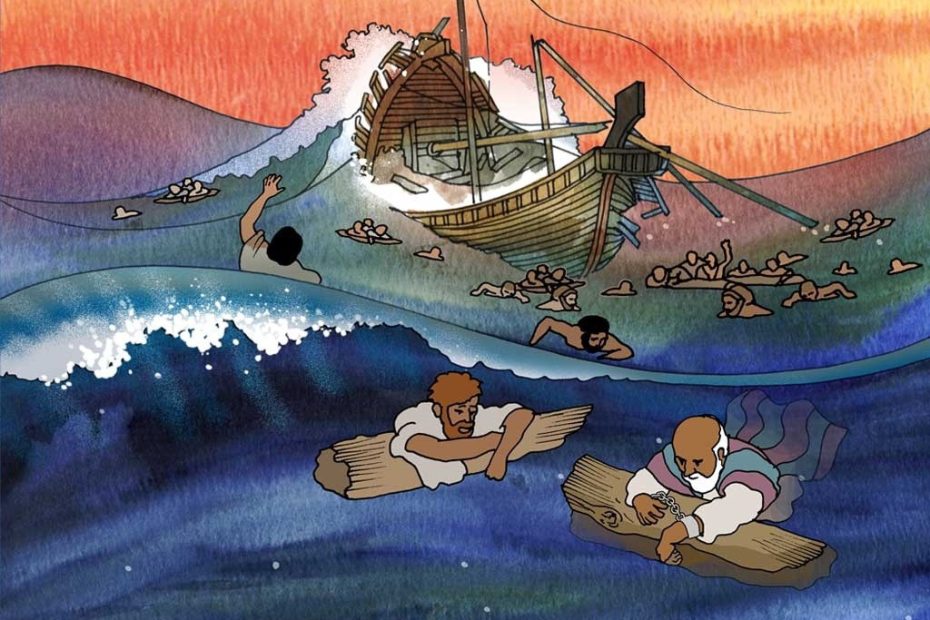
39-41. “When it was day, the pilot saw where they were and made every effort to get the ship to shore. But it was all futile; the ship was grounded and the waves began to beat the stern to pieces. The only thing passengers could do was jump into the water and make for land.” (Wiersbe, 510)
42. “The soldiers, of course, were concerned abut their prisoners, for if a prisoner escaped, the soldier was held accountable and could be killed.” (Wiersbe, 510)
43-44. “Just as the Lord promised, all of them made it safely to shore.” (Wiersbe, 510)
References
Holman Christian Standard Bible (HCSB)
Copyright © 1999, 2000, 2002, 2003, 2009 by Holman Bible Publishers, Nashville Tennessee. All rights reserved.
New American Standard Bible (NASB)
New American Standard Bible®, Copyright © 1960, 1971, 1977, 1995, 2020 by The Lockman Foundation. All rights reserved.
New King James Version (NKJV)
Scripture taken from the New King James Version®. Copyright © 1982 by Thomas Nelson. Used by permission. All rights reserved.
In this article Scripture quotations taken from KJV.
McGee, J. Vernon, Thru the Bible: Volume V. Nashville: Thomas Nelson, 1983
Max Anders and Kenneth O. Gangel (2012). HNTC Vol. 05: Acts. B&H Publishing Group. Retrieved from https://read.lifeway.com
Polhill, John B., The New American Commentary, Volume 26, Acts, © Copyright 1992, Broadman Press
The Moody Bible Commentary, The Moody Bible Institute of Chicago, Moody Publishers, Chicago, IL, 2014
Wiersbe, Warren W, The Bible Exposition Commentary New Testament Volume 2. Colorado Springs: David C Cook, 1989
