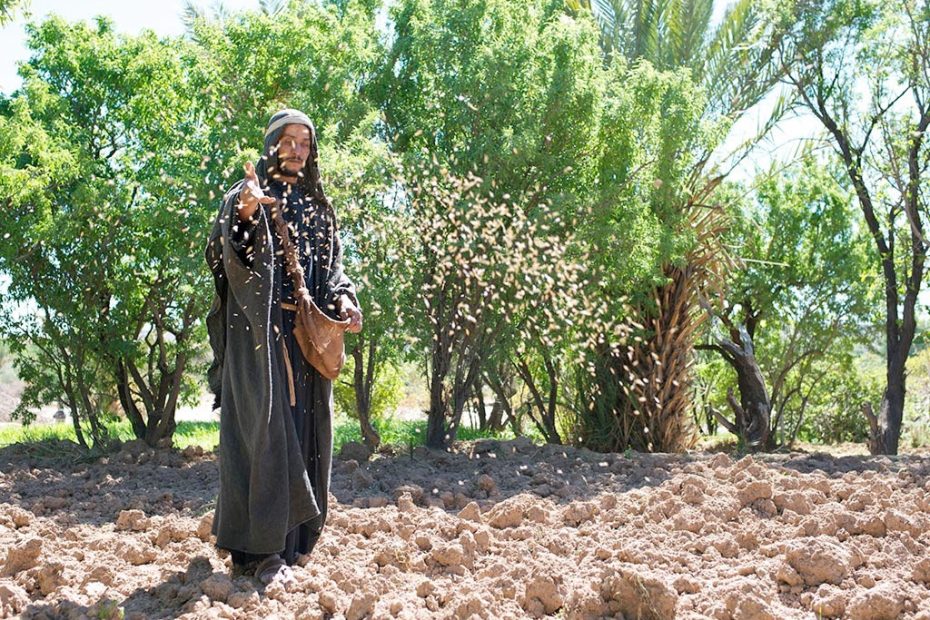
Soil
This begins with a parable about soil. It includes several parables. It ends with a woman being healed and a child raised from the dead!
This is a Bible Study. Have your own Bible handy to look up the references mentioned.
If you do not have a Bible, I invite you to go to BibleGateway.com or another online Bible.
1. “What follows in this chapter and beyond are examples of how Jesus and his followers preached the kingdom so everyone could hear.” [Max Anders and Trent C. Butler (2012). HNTC Vol. 03: Luke. B&H Publishing Group. Retrieved from https://read.lifeway.com]
2. “That certain women followed Jesus indicates that his attitude toward women was quite different from the attitude of most first-century rabbis (cf. John 4:27).” (Stein, H. Robert, The New American Commentary Volume 24, Luke. [Broadman Press, 1996], 240)
“Mary Magdalene (from the unidentified city of Magdala) had good reason to follow Jesus. He had exorcised demons from her, transforming her life from a person totally possessed to an individual totally pursuing committed discipleship.” [Max Anders and Trent C. Butler (2012). HNTC Vol. 03: Luke. B&H Publishing Group. Retrieved from https://read.lifeway.com]
3. “Luke seems to have had good information concerning the household of Herod Antipas which may have come to Luke via Joanna.” (Stein, 243)
Susanna is only mentioned here in the New Testament.
Jesus “treated women with respect and esteem, and they showed their appreciation by supporting His mission (8:3c).” (The Moody Bible Commentary, The Moody Bible Institute of Chicago, [Moody Publishers, Chicago, IL, 2014], 1565)
Sower
4. “The seed is the Word of God, for, like seed, the Word has life and power (Heb. 4:12) and can produce spiritual fruit (Gal. 5:22-23). “(Wiersbe, Warren W, The Bible Exposition Commentary New Testament Volume 2. [Colorado Springs: David C Cook, 1989]. 200)
5. “Some seed fell beside the road (8:5b) on the edges of the footpaths where it was trampled under foot (8:5c), hence, ruined.” (The Moody Bible Commentary, The Moody Bible Institute of Chicago, [Moody Publishers, Chicago, IL, 2014], 1563)
6. “This rock was under a thin layer of soil.” (Stein, 244)
7. “This soil illustrates the person who does not repent and ‘weed out’ the things that hinder the harvest.” (Wiersbe, 200)
8. “It illustrates the individual who hears the Word, understands it, receives it within, is truly saved, and proves it by patiently producing good fruit (see 1 Thess. 2:13; 1 Peter 1:22-25).” (Wiersbe, 200)
9. “Listen as they might, the disciples did not understand. At least they had the faith and trust to speak up and ask Jesus. Jesus singled them out. Only they were supposed to understand the parables.” [Max Anders and Trent C. Butler (2012). HNTC Vol. 03: Luke. B&H Publishing Group. Retrieved from https://read.lifeway.com]
10. “These secrets refer to different aspects of the arrival of God’s kingdom, which Jesus has shared with the disciples.” (Stein, 245)
Explanation
11. “Luke emphasized that the gospel message the disciples proclaimed and which he was writing has God as its source, not human beings (cf. 1 Thess 2:13).” (Stein, 246)
12 (5). “This soil represents the person who hears the Word but immediately allows the devil to snatch the seed away.” (Wiersbe, 200)
13 (6). “This soil illustrates the emotional hearer who quickly responds to the message, but his interest wanes and he does not continue (see. John 8:31-32).” (Wiersbe, 200)
14 (7). “This soil illustrates the person who does not repent and ‘weed out’ the things that hinder the harvest.” (Wiersbe, 200)
15 (8). “This soil alone is fruitful. It illustrates the individual who hears the Word, understands it, receives it within, truly saves, and proves by patiently producing fruit.” (Wiersbe, 200)
Lamp
16-18. “Using a metaphor of a lamp, Jesus revealed three qualities of His teaching:
(1) It was itself fully visible and illuminating (of the heart/soil (8:16).
(2) It exposed what was hidden (it will expose what sort of ‘soil’ one’s heart is (8:17).
(3) It is to be heeded (8:18).”
19-21. “He was not denying His family relationship but getting ready to declare one infinitely deeper, higher, and more permanent, transcending by far any blood relationship. This brings a believer mighty close to Him. (McGee, J. Vernon, Thru the Bible: Volume IV. [Nashville: Thomas Nelson, 1983], 281)
Storm
22-23. “The scene depicted here was mundane and commonplace (8:22), and the sailing was serene enough that Jesus fell asleep (8:23a). A fierce gale arose, (8:23b), and the boat was in danger of capsizing (8:23c).” (Moody, 1566)
24. “The miracle lies in the fact that the wind ceased immediately, and the sea, which would have rolled for hours, instantly became as smooth as glass.” (McGee, 282)
25. “How often He puts us in the storms of life in order that we might come closer to Him and learn what manner of Man He really is.” (McGee, 282)
Demons
26. “The eventful boat ride ended at a place Luke identified as the country of the Gerasenes (8:26).” (Moody, 1567)
27. “For Luke and his readers it described the demoniac’s terrible condition of alienation from other people and perhaps even his and the demon’s association with death.” (Stein, 256)
28. “Upon seeing Jesus, the man cried out, addressing Jesus in terms that indicated His divine Sonship and majesty, and begging Jesus not to torment him.” (Moody, 1567)
29. “These statements were actually the voices of the demons, who had abused the man for some time.” (Moody, 1567)
30-31. “The man was actually possessed by many demons—Legion. Apparently not wanting to be disembodied—a prelude to ultimate punishment in the abyss (8:31)—but nevertheless knowing they were powerless to resist His command to leave the man” (Moody, 1567)
32. “Pigs are forbidden and unclean for Jews since they do not ‘chew the cud’) Lev 11:7; Deut 14:8). For a Jew therefore pigs would be a very appropriate home for the demons.” (Stein, 257)
33. “The demons were conquered, not converted! The swine’s destruction proves that the demons truly left the man.” (Stein, 257)
34. “News of the event spread rapidly.” (Moody, 1567)
35-37. “Rather than marveling at the liberation and restoration of the now demon-delivered man (8:36), whom they surely all knew well (8:36b), the residents were fearful and requested that Jesus leave their country (8:37).” (Moody, 1567)
38-39. “Luke described how the demon-delivered man requested to go with Jesus (8:38). He was denied, but was given the task of spreading the message of the great things God had done for him (8:39).” (Moody., 1567)
“It was important that a witness to the Lord remain even in this country that had turned Jesus away.” (Moody, 1567)
Healing
40. “Jesus returned, apparently across the sea to Capernaum, to the crowds he normally faced (see vv. 4,19).” [Max Anders and Trent C. Butler (2012). HNTC Vol. 03: Luke. B&H Publishing Group. Retrieved from https://read.lifeway.com]
41-42. “Jairus came to get Jesus to heal his daughter, not to raise her from the dead. His faith was small, but his situation was desperate. He believed that Jesus would have to touch her.” (McGee, 284)
43. “The woman’s plight is highlighted by the length of her illness (twelve years) and the hopelessness of her situation (no one could heal her).” (Stein,
2361)
44. “Why the woman chose to touch this part of His garment, we do not know, but Jesus knew somebody with faith had touched Him and had been healed by His power. The healing was immediate and complete.” (Wiersbe, 204)
45. “Peter laughed it off. Who could possibly know in this mob? Everybody was elbowing their way in and touching him? How could he limit it to one person?” [Max Anders and Trent C. Butler (2012). HNTC Vol. 03: Luke. B&H Publishing Group. Retrieved from https://read.lifeway.com]
Healed
46.” Jesus knew one person had taken special healing power from him. He wanted to talk to that one person in this big crowd.” [Max Anders and Trent C. Butler (2012). HNTC Vol. 03: Luke. B&H Publishing Group. Retrieved from https://read.lifeway.com]
47. “Why did the Lord ask her to give witness publicly? Was this not an embarrassment to her? Not in the least. To begin with, this public confession was for her sake. It was an opportunity for her to confess Christ and glorify God.” (Wiersbe, 203)
48. “Jesus’ blessing—the only place where He addresses as Daughter—assured her that because her faith in Him was genuine, her healing by Him was complete.” (Moody, 1567)
49-50. “A messenger from Jairus’ house stopped him: ‘Jairus, no need to trouble the Master. Your dear daughter died.” Jesus had another message for Jairus: ‘Have faith. She will live.’ Who should the Jewish leader believe, his longtime servants or this nomadic rabbi? Jairus went with Jesus.” [Max Anders and Trent C. Butler (2012). HNTC Vol. 03: Luke. B&H Publishing Group. Retrieved from https://read.lifeway.com]
51. Jesus “put them all out! This situation was much too tender and special for Him to allow dozens of unbelieving spectators to watch.” (Wiersbe, 204)
52-53. “He rebuked the ‘professional mourners’ and commanded them to stop weeping as He explained she was not dead but sleeping. The ‘laughter’ of this crowd showed their disingenuousness.” (Moody, 1568)
54-55. “Jesus tenderly took the child’s hand and spoke softly to her—Child arise!…The healing was ‘immediate’—her sprit returned (1 Kg 17:21-22).” (Moody, 1568)
56. “When Jesus returned the girl to her amazed—and no doubt grateful—parents, He instructed them not to spread the news of this event around.” (Moody, 1568)
References
Holman Christian Standard Bible (HCSB)
Copyright © 1999, 2000, 2002, 2003, 2009 by Holman Bible Publishers, Nashville Tennessee. All rights reserved.
New American Standard Bible (NASB)
New American Standard Bible®, Copyright © 1960, 1971, 1977, 1995, 2020 by The Lockman Foundation. All rights reserved.
New King James Version (NKJV)
Scripture taken from the New King James Version®. Copyright © 1982 by Thomas Nelson. Used by permission. All rights reserved.
In this article Scripture quotations taken from KJV.
McGee, J. Vernon, Thru the Bible: Volume IV. Nashville: Thomas Nelson, 1983
Max Anders and Trent C. Butler (2012). HNTC Vol. 03: Luke. B&H Publishing Group. Retrieved from https://read.lifeway.com]
The Moody Bible Commentary, The Moody Bible Institute of Chicago, Moody Publishers, Chicago, IL, 2014
Stein, H. Robert, The New American Commentary Volume 24, Luke. Broadman Press, 1996
Wiersbe, Warren W, The Bible Exposition Commentary New Testament Volume 2. Colorado Springs: David C Cook, 1989
