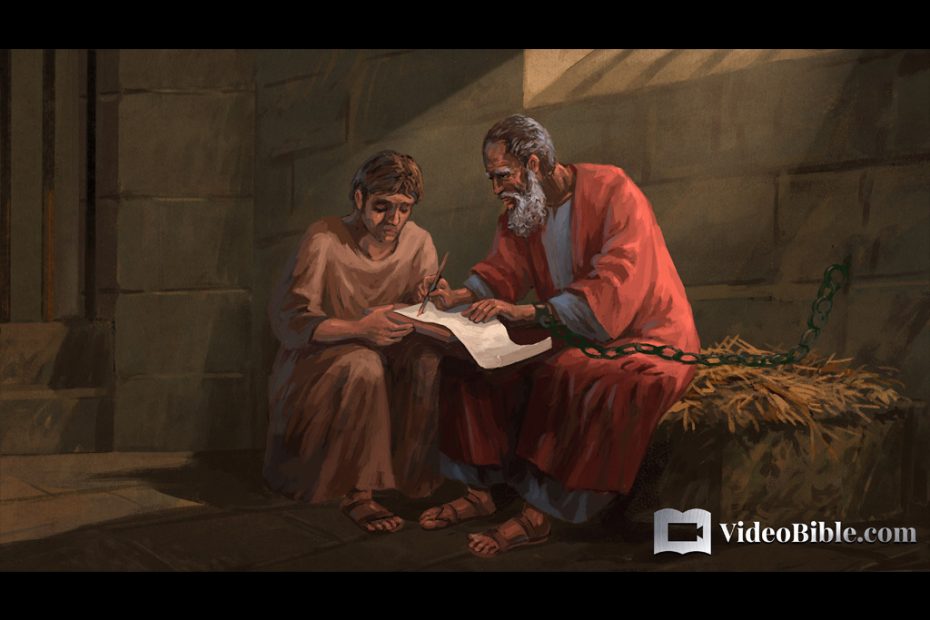
Slave
Philemon owned a slave, Onesimus. Philemon was converted to Christ when Paul was in Colosse. Onesimus was in Rome and served Paul while there. Paul wanted him to return to Colosse and serve Philemon.
This is a Bible Study. Have your own Bible handy to look up the references mentioned.
If you do not have a Bible, I invite you to go to BibleGateway.com or another online Bible.
1. “In his greeting, Paul expressed his deep love for his Christian friends, and he reminded them that he was a prisoner for Jesus Christ. Timothy was included in the greeting, though the burden of the letter was from the heart of Paul to the heart of Philemon.” (Wiersbe, Warren W, The Bible Exposition Commentary New Testament Volume 2. [Colorado Springs: David C Cook, 1989], 270)
2a “Apphia was apparently the wife of Philemon. He (Philemon) met and married a Phrygian girl named Apphia. They both now have become Christians.” (McGee, J. Vernon, Thru the Bible: Volume V. [Nashville: Thomas Nelson, 1983], 493)
2b. “The third person is Archippus. Because of the family context, many assume he was the son of Philemon and Apphia Paul addressed ‘the church that meets in your home.’” (Lea, Thomas D., The New American Commentary Volume 34, [Broadman Press, © 1992], 350)
3. “This is the usual greeting of Paul to every person and every church to which he wrote.” (McGee, 499)
Prayer
4. “The thought here is that every time Philemon’s name was mentioned, Paul prayed for him. This would indicate that Philemon was a rather prominent person.” (McGee, 499)
5. “He (Philemon) showed love toward the Lord Jesus and toward other believers. His faith was toward the Lord Jesus, and he was faithful to other believers.” (McGee, 499)
6. “Paul prayed that Philemon would use this knowledge to work out the implications of his faith in the matter with Onesimus. The ‘good thing’ he knew to do was to forgive an erring and repentant brother who sinned before his salvation.” (Lea, 355)
7. “Paul had great joy and consolation in the love of Philemon for other believers and for him It is the inner life of the believers that had great satisfaction through him.” (McGee, 499)
Appeal
8. “Paul preferred to speak gently to Philemon. Philemon was a man of Christian character, and Paul approached him out of love (v. 7).” (Lea, 358)
9. “Philemon was to act in a Christian manner, but even that could be coerced. For that reason, Paul based his appeal on love. He had a specific love in mind, that of vv. 5, 7. Philemon’s love should prove true in this case, as it had in so many others.” (Lea, 359)
10. “Onesimus was no longer ‘just a slave’; he was now Paul’s son in the faith and Philemon’s Christian brother! In Jesus Christ, there is ‘neither bond nor free’” (Gal. 3:28). (Wiersbe, 271)
11. “Onesimus had a change of character. In describing that change, Paul used a double play on words. Onesimus was ‘useless’; now he was ‘useful.” (Lea, 361)
12. “Paul is asking Philemon to receive Onesimus just as if he was receiving Paul.” (McGee, 500)
13. “Paul saw many ways Onesimus could be of service to him in his imprisonment. Their fellowship was good, and he lifted Paul’s spirits at a difficult time.” (Lea, 362)
14. “Paul is saying, ‘I wouldn’t keep Onesimus because that wouldn’t be right—although I thought of it. If you willingly want to send him back to me, that will be all right.’” (McGee, 500)
15-16. “Philemon was to recognize Onesimus as a Christian and therefore, as a genuine brother. Their union had three dimensions. They were united in humanity, a brotherhood in itself. They were fellowship-Christians and fellow servants of the Lord, a stronger brotherhood.” (Lea, 365)
Partner
17. “The word receive in Philemon 17 means ‘to receive into one’s family circle.’ Imagine a slave entering his master’s family! But imagine a guilty sinner entering God’s family!” (Wiersbe, 271)
18-19. “Apparently, Paul owed Philemon nothing. His ‘account,’ therefore, meant that he was willing to assume an indebtedness for this newfound Christian friend. This assured Philemon that Paul fully expected him to forgive Onesimus his wrongs.” (Lea, 366)
20. “Philemon already owed Paul a larger debt: redemption of his very life. Because these three are family in Christ, brotherly love shown to Onesimus not only refreshes the slave but Paul as well (cf. 7; 1Co 12:26).” (Moody, 1919)
21. “Perhaps when Paul says that Philemon will obey even more than what I say It is a veiled reference to Philemon freeing Onesimus the slave; but it is uncertain.” (Moody, 1919)
22. “As an itinerant church planter, Paul was dependent on Christian hospitality. He was confident that Philemon’s congregation (your, 22, is plural) was praying for him.” (Moody, 1919
23-24. “The persons identified all appear in Colossians. This gives evidence of the same origin and date for both epistles. Further, these men were well-known by Philemon and his house church, even as they were known at Colosse and Laodicea.” (Lea, 369)
25. “Paul ended the epistle with a prayer for God’s grace. Paul commonly began and ended with God’s grace. Particularly, if Philemon were to accomplish the task that lay before him, he would need a special portion of God’s grace.” (Lea, 3690)
References
Amplified Bible (AMP)
Copyright © 2015 by The Lockman Foundation, La Habra, CA 90631. All rights reserved.
Holman Christian Standard Bible (HCSB)
Copyright © 1999, 2000, 2002, 2003, 2009 by Holman Bible Publishers, Nashville Tennessee. All rights reserved.
New American Bible (Revised Edition) (NABRE)
Scripture texts, prefaces, introductions, footnotes and cross references used in this work are taken from the New American Bible, revised edition © 2010, 1991, 1986, 1970 Confraternity of Christian Doctrine, Inc., Washington, DC All Rights Reserved. No part of this work may be reproduced or transmitted in any form or by any means, electronic or mechanical, including photocopying, recording, or by any information storage and retrieval system, without permission in writing from the copyright owner.
New King James Version (NKJV)
Scripture taken from the New King James Version®. Copyright © 1982 by Thomas Nelson. Used by permission. All rights reserved.
In this article Scripture quotations taken from KJV.
Blomberg, Craig L., The New American Commentary, Volume 22, Matthew. Nashville: Broadman Press
McGee, J. Vernon, Thru the Bible: Volume IV. Nashville: Thomas Nelson, 1983
MacArthur, John, The MacArthur Bible Commentary. Nashville, Thomas Nelson Inc., 2005
Robertson, A. T., A Harmony of the Gospels. New York, HarperCollins Publishers, 1950
Smith, Gary V., The New American Commentary, Volume 15B, Isaiah 40-66. Nashville, B & H Publishing Group, 2009
Wiersbe, Warren W, The Bible Exposition Commentary New Testament Volume 1 Matthew-Galatians. Colorado Springs: David C Cook, 2004
