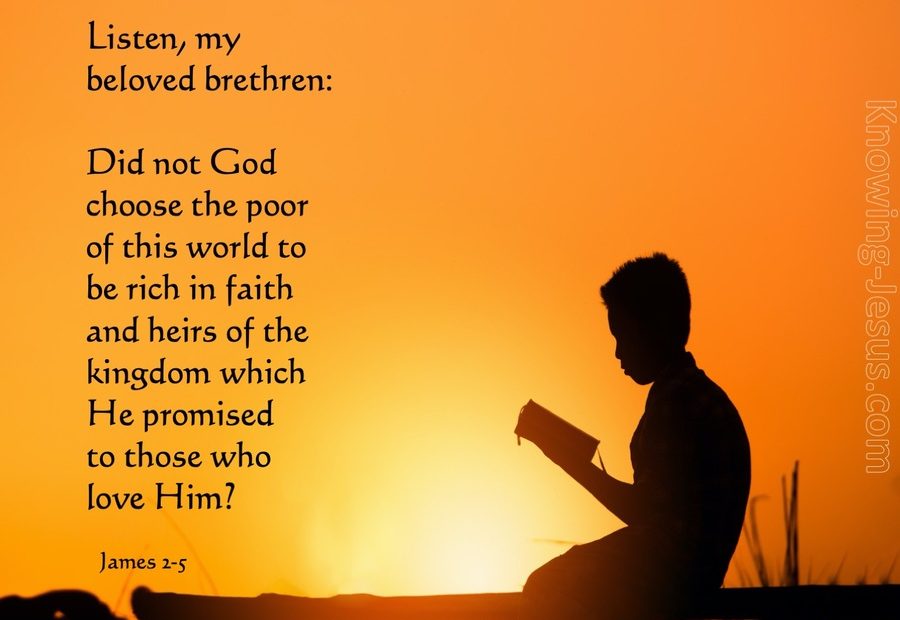
Faith
Do you only have faith? Jesus wants us to have works to prove our faith. Without works you are not showing your belief in Jesus or His Father.
The members of the Thessalonian church were enthusiastic about their church, and they shared their faith.
This is a Bible Study. Have your own Bible handy to look up the references mentioned.
If you do not have a Bible, I invite you to go to BibleGateway.com or another online Bible.
1. “Not only is the mature Christian patient in testing (James 1), but he also practices the truth. This is the theme of James 2. Immature people talk about their beliefs, but the mature person lives his faith.” (Wiersbe, Warren W, The Bible Exposition Commentary New Testament Volume 2. [Colorado Springs: David C Cook, 1989], 350)
2. “Showing favoritism or honor to anyone other than Christ disregards the exclusive glory the belongs to Him (our glorious Lord). (The Moody Bible Commentary, The Moody Bible Institute of Chicago, [Moody Publishers, Chicago, IL, 2014], 1951)
3a. “James illustrates partiality with a rich man who comes into the reader’s assembly or church meeting (vv. 2-4; cf. 1Co 14:23-25) and is given special attention.“ (Moody, 1951)
3b. “To the poor man he insisted, ‘Sit on the floor by my feet.’ In all likelihood the good seat offered to the rich man included a footstool.“ (Richardson, Kurt A., The New American Commentary Volume 36, [Broadman Press, © 1997], 112)
4. “After James has put these two men in contrast, he asks, ‘Aren’t you actually being partial in yourselves or aren’t you making distinctions among yourselves and becoming judges with evil motives?’” (McGee, J. Vernon, Thru the Bible: Volume V. [Nashville: Thomas Nelson, 1983], 647)
Poor
5. “Poor believers are not the only ones who will be saved, but they, above all, demonstrate God’s gracious saving work. Their love (cf. 1:12) is typically the most striking.” (Richardson, 115)
6. “The act of shaming the poor was inseparable from the simultaneous act of honoring the rich. To act this way, the Christian assembly had to disregard the honor God has bestowed on the poor who love him.” (Richardson, 116)
7. “When you mistreat the poor, you are blaspheming the name of Christ.” (McGee, 647)
8. “James reached back into the Old Testament for one of God’s laws. ‘Thou shalt love thy neighbor as thyself’ (Lev. 19:18). In His parable of the good Samaritan, Jesus told us that our neighbor is anyone who needs our help (Luke 10:25-37).” (Wiersbe, 352)
9. “James now indicated what was so wrong about the world’s wealth and its system of honor: to play favorites is to commit sin. The continuing sense of Leviticus 19 is at work in the text.” (Richardson, 120)
Obey
10. “James is not saying that if you break one commandment, you have broken them all. He is saying you are guilty of breaking the commandments no matter which one it is that you broke.” (McGee, 647)
11. “God is ‘one’ (cf. Jms 2:19) and spoke against both Adultery and Murder. To violate either one makes a person a transgressor of the law.” (Moody, 1951)
12. “The ‘law of liberty’ is the law of Christ. The Lord Jesus said, ‘If you love me, keep my commandments’ (John 14:15). ‘This is my commandment, That ye love one another, as I have loved you’ (John 15:12).” (McGee, 648)
13. “Love and mercy define the ‘law of freedom.’ Rejecting this liberating law means falling under judgment of the whole law.” (Richardson, 125)
Faith
14. “A person might say he or she has faith, but what is that claim without the deeds that reveal all authentic faith?” (Richardson, 128)
“James emphasized: faith without deeds is good to no one…The deeds of faith demonstrate the validity of the claim to be a believer; without them the claim is empty or ‘dead’—but more importantly, without deeds the needs do not receive help.” (Richardson, 128, 129)
15. “A poor believer came into a fellowship, without proper clothing and in need of food. The person with dead faith noticed the visitor and saw his needs but he did not do anything to meet the needs.” (Wiersbe, 354)
16. “All he did was say a few pious words! ‘Go, I wish you well; keep warm and well fed. But the visitor went away just as hungry and naked as he came in!” (Wiersbe, 354)
17. “In the same way that a word of blessing amounts to nothing without the act of blessing, faith without action is dead Faith that does not contain within it the will or spring of action appropriate to faith is dead.” (Richardson, 132)
Works
18. “A claim to faith without works cannot be compared to a claim of faith with works A lifeless faith cannot be shown to be alive The claim of faith is empty where there is no action, and thus no proof of faith is possible.” (Richardson, 134)
19. “Believers should be doing more than shuddering, just as they should be doing more than merely professing belief.” (Richardson, 135)
20. “Faith without the fruit of faith is empty and futile as far as the world is concerned.” (McGee, 651)
21. “Abraham exemplifies the necessity of deeds with faith but is not described in terms of anything else suggests that Jewish or Gentile identity is not at issue.” (Richardson, 137)
22. “James wanted it known that without action, faith cannot be complete. Without action there will be no perseverance (cf. 1:3), and without sustained perseverance faith will not be complete.” (Richardson, 139)
God’s Friend
23. “James summed up what he had to say about the example of Abraham by citing a choice title for him within the Old Testament: ‘God’s friend’ (cf. 2 Chr 20:7; Isa 41:8).” (Richardson, 141)
24. “James was calling attention to two ways of justification: by faith before God, and by works before people. While one is justified (declared righteous) before God by faith alone, one is justified (demonstrates his godliness) before people by his or her works.” (Moody, 1952)
25. “By faith (Heb 11:31) Rahab the harlot received the Jewish spies and hid them in her house (Jos 2:1-24). She could have betrayed the spies, but she sent them out by another way, adding works to her faith.” (Moody, 1952)
26a. “For a body to be active and alive, it must have a spirit. So also faith in Christ must have works added to it since works give vitality and energy to faith. On dead faith, (see 2:17).” (Moody, 1952)
26b. “Rahab could have had dead faith, a mere intellectual experience But she exercised dynamic faith, her mind knew the truth, her heart was stirred by the truth, and her will acted on the truth. She proved her faith by her works.” (Wiersbe, 356)
References
Holman Christian Standard Bible (HCSB)
Copyright © 1999, 2000, 2002, 2003, 2009 by Holman Bible Publishers, Nashville Tennessee. All rights reserved.
McGee, J. Vernon, Thru the Bible: Volume V. Nashville: Thomas Nelson, 1983
Richardson, Kurt A The New American Commentary Volume 36, [Broadman Press, © 1997]
The Moody Bible Commentary, The Moody Bible Institute of Chicago, [Moody Publishers, Chicago, IL, 2014]
Wiersbe, Warren W, The Bible Exposition Commentary New Testament Volume 1 Matthew-Galatians. Colorado Springs: David C Cook, 2004
How To Become a Christian
