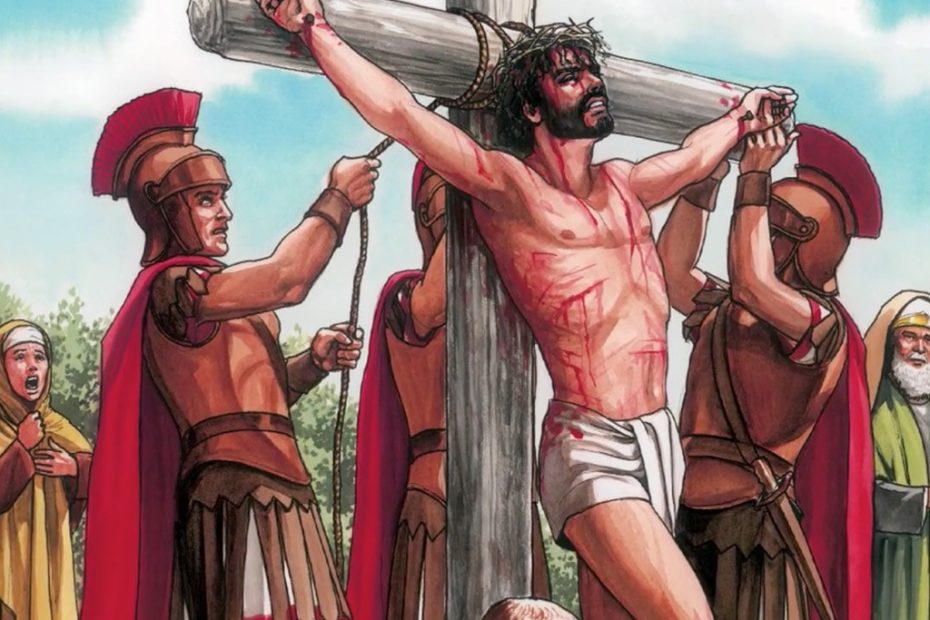
Crucifixion
Jesus was sentenced to death by Crucifixion. This covers many of the events that led to His death by Crucifixion.
This is a Bible Study. Have your own Bible handy to look up the references mentioned.
If you do not have a Bible, I invite you to go to BibleGateway.com or another online Bible.
1. “Three times during the trial, Pilot clearly affirmed the innocence of Jesus (Luke 23:4, 14, 22).” (Wiersbe, Warren W, The Bible Exposition Commentary New Testament Volume 2. [Colorado Springs: David C Cook, 1989], 273)
2. “Dr. Luke reported three other witnesses besides Pilate who also said, ‘not guilty!’: King Herod (Luke 23:15), one of the malefactors (Luke 23:40-43), and a Roman centurion (Luke 23:47).” (Wiersbe, 273)
3. “Pilate bluntly asked Jesus to answer his accusers. Would he confess to being king of the Jews as charged…Neither the Jews nor Pilate could take the answer as clear evidence of guilt to the charge of being a king in opposition to Rome.” [Max Anders and Trent C. Butler (2012). HNTC Vol. 03: Luke. B&H Publishing Group. Retrieved from https://read.lifeway.com]
4. “This is Pilate’s first proclamation of Jesus’ innocence.” (Stein, H. Robert, The New American Commentary Volume 24, Luke. [Broadman Press, 1996], 575)
5. “Now the religious rulers accuse Jesus of leading a revolution. They say that He had rebelled against constituted authority.” (McGee, J. Vernon, Thru the Bible: Volume IV. [Nashville: Thomas Nelson, 1983], 351)
Herod
6-7. “Upon their mentioning of Galilee, Pilate saw a possible opening to avoid further involvement in the matter. He would refer Jesus to Herod (Antipas, ruler of Galilee who had also ordered John the Baptist’s execution, cf. 13:31) who happened to be visiting Jerusalem for Passover.” (The Moody Bible Commentary, The Moody Bible Institute of Chicago, [Moody Publishers, Chicago, IL, 2014], 1597)
8-9. “Herod used provoking questions to try to force Jesus’ hand so he could see a miracle. Having survived Pilate’s court, Jesus wanted no part of Herod’s trial. So he gave him no answer.” [Max Anders and Trent C. Butler (2012). HNTC Vol. 03: Luke. B&H Publishing Group. Retrieved from https://read.lifeway.com]
10. “Once again, it is an example that through it all Jesus was in control. However, His accusers were again vehemently pressing their case.” (Moody, 1598)
11. “The king finally became so bold as to mock Jesus and permit his soldiers to dress Him in ‘an elegant robe,’ the kind that was worn by Roman candidates for office.” (Wiersbe, 273)
12. “The only thing accomplished by this maneuver was the mending of a broken friendship. Herod was grateful to Pilate for helping him to see Jesus and for honoring him by asking his counsel.” (Wiersbe, 273)
Barabbas
13. “Since Herod had not relieved him of the responsibility of dealing with Jesus, Pilot once again found himself before the Jewish religious authorities.” (Moody, 1598)
14-15. “The charges against Jesus were, indeed, groundless—He was simply an innocent man—and this was the opinion of Herod as well.” (Moody, 1598)
16. “The intended ‘punishing’ of Jesus would involve a beating or whipping, but not the more severe ‘scourging’ that preceded crucifixion. Luke revealed to his readers that Pilate clearly wanted to release Jesus.” (Stein, 580)
17. “Luke informed the reader that, not only had he found Jesus innocent but Pilate also was using a recognized custom, an act of clemency, to release Jesus (23:27; this verse is not found in a few of the oldest Gk. mss).” (Moody, 1598)
18. “The identity of those who cried out for Christ’s crucifixion is not clear. At least the rulers of Israel are meant. Most likely the crowd is included, though not explicitly (cf. Acts 3:14-15).” [Max Anders and Trent C. Butler (2012). HNTC Vol. 03: Luke. B&H Publishing Group. Retrieved from https://read.lifeway.com]
19. “Only here does Luke mention Barabbas by name, identifying him as a murderer and instigator of rebellion against Rome.” [Max Anders and Trent C. Butler (2012). HNTC Vol. 03: Luke. B&H Publishing Group. Retrieved from https://read.lifeway.com]
Shouting
20-21. “Pilate again sought to release Jesus (cf. 23:16, 22).” But the crowd kept shouting to crucify Him. (Stein, 582)
22. “Luke pointed out to his readers that Pilate declared Jesus innocent not just once but three times.” (Stein, 582)
23. “Again Luke emphasized that Pilate personally saw no guilt in Jesus but was intimidated by the Jewish leadership and the crowd.” (Stein, 582)
24-25 “Pilate capitulated to the will of the people—he condemned Jesus and released the insurrectionist.” (Moody, 1598)
Carrying the Cross
26. “Before Simon met Jesus, he had religion and devotion, but after he met Jesus, he had reality and salvation. He did both a physical and spiritual ‘about face’ that morning, and it transformed his life.” (Wiersbe, 274)
27. a) There was a “brief encounter between Jesus and some women, the professional mourners (not those who had followed Jesus during His ministry) who were dutifully, if somewhat mechanically, performing their duties.” (Moody, 1598)
b) “Even in His weakened condition Jesus took the opportunity to offer a word of warning to those women and the crowd.” (1598)
28. “Instead of expressing appreciation for their sentiments on His behalf, He surprisingly admonished them to direct their lamentations, not for Him, but for themselves and their children.” (Moody, 1598)
29. “While they were weeping over the injustice of one man’s death, He was looking ahead and grieving over the terrible destruction of the entire nation, a judgement that was wholly justified.” (Wiersbe, 274)
30. “In those days men would prefer being covered with earth—i.e., death—rather than face the judgment that was about to befall them. Jesus quoted Hs 10:8 and Is 2:19, both context that speak of judgement.” (Moody, 1599)
31. “The implication of this statement is that all hopes rest in the green tree of Jesus on Calvary, not in a new political leader on a Jewish throne in Jerusalem and not in a new religious priest in a purified temple in Jerusalem.” [Max Anders and Trent C. Butler (2012). HNTC Vol. 03: Luke. B&H Publishing Group. Retrieved from https://read.lifeway.com]
Crucifixion
32. “It had been prophesied that the Suffering Servant would be ‘numbered with the transgressors’ (Isa. 53:12; Luke 23:37), and two criminals were crucified with Jesus, men who were robbers (Matt. 27:38).” (Wiersbe, 274)
33. “Two criminals were crucified with the Lord.” (McGee, 353)
34. “The Lord asked His Father to forgive the crowd for crucifying Him. If he had not done this, the crowd would have been guilty of committing the unpardonable sin of putting to death the Son of God.” (McGee, 353)
35. “The activity around the cross involved the soldiers playing games of chance with His garments as the prize (Ps 22:18) and several groups of people mocking and berating Him.” (Moody, 1599)
Mocking
36. “This is Luke’s first mention of the role of the Roman military in the crucifixion. They produce the second mocking of Jesus (cf. 23:35, 39).” (Stein, 590)
37-38. “No person can preserve his or her life for eternity. Eternal life is God’s gift, given by the one who died on the cross. Refusing to save himself, he provided salvation for the world.” [Max Anders and Trent C. Butler (2012). HNTC Vol. 03: Luke. B&H Publishing Group. Retrieved from https://read.lifeway.com]
39. “Luke noted the abuse that Jesus received from the criminals, but unlike the others he recorded that while the abuse came from one of the criminals the other criminal defended Jesus.” (Moody, 1599)
40. “The second criminal responded in three ways. First, he rebuked the mocking criminal, acknowledging the justice of their punishment (23:40-41a). Second, he defended Jesus, acknowledging the Lord’s innocence (23:41b). Third, he made a request of Jesus, demonstrating his faith.” (Moody, 1599)
42. “In the simple request, Jesus, remember me when you come into Your kingdom (23:43), the criminal affirmed his belief that Jesus was the Messiah and the King of the Jews, since he expected Jesus to have a kingdom, and that He could save him—remember me.” (Moody, 1599)
43. “As a result, the criminal received a promise—Today, you shall be with Me in Paradise (heaven; Rv 2:7).” (Moody, 1599)
Death
44-45. “Darkness, the symbol of Satan’s power, ruled the land for three hours. The time reckoning apparently places the beginning of this darkness at the most unlikely of times: high noon. This makes clear Jesus’ statement to the Jewish leaders that they had an hour, an hour when darkness rules the earth (22:53).” [Max Anders and Trent C. Butler (2012). HNTC Vol. 03: Luke. B&H Publishing Group. Retrieved from https://read.lifeway.com]
46. “Jesus, knowing that he had completed his departure/exodus (Luke 9:31), committed his spirit, i.e., his life, into his Father’s hands in order to enter into his glory (24:26).” (Stein, 596)
47. “At the foot of the cross he looked up and saw that something unusual was taking place, and he could glorify God. He saw that Christ was a righteous man.” (McGee, 354)
48-49. “’What had happened’…this involves such things as darkness, Jesus’ behavior against his enemies (23:34), his words to the criminal (23:43), his prayer to the Father (23:46), and his giving up of his life (23:46).” (Stein, 596)
Burial
50. “Joseph…was a member of the Sanhedrin…He was a man who stood alone when he took a stand for Christ.” (McGee, 355)
51. “At the time of the Crucifixion the disciples went underground, and those that had been underground came out in the open…John’s gospel tells us that Nicodemus joined with Joseph in burying the Lord Jesus.” (McGee, 355)
52. “The faith of Joseph is out in the open now. As a man of means and influence he asks for the body of Jesus.” (McGee, 355)
53. “As in Mark 15:46, Joseph is described as personally having removed Jesus’ body from the cross.” (Stein, 599)
“Luke alone commented that the tomb was cut out of the rock. Usually victims of crucifixion were buried in a common pit. Jesus, however, although he was crucified between two criminals, was buried as a criminal.” (Stein, 600.)
54. “This refers to the day before the Sabbath, as the rest of the verse makes clear, rather that the day before the Passover. Since the Sabbath began at sunset Friday, this refers to late Friday afternoon.” (Stein, 600)
55. “They were able to return to this place in Luke 24:1. This makes it impossible to think of the resurrection as a myth based upon the women’s having come to a wrong, empty tomb.” (Stein, 600)
56. “The women (cf. 23:49) made sure they knew where the tomb was (23:55) so that they could return there after preparing spices and perfumes to complete the rituals of burial.” (Moody, 1600)
References
Holman Christian Standard Bible (HCSB)
Copyright © 1999, 2000, 2002, 2003, 2009 by Holman Bible Publishers, Nashville Tennessee. All rights reserved.
New American Standard Bible (NASB)
New American Standard Bible®, Copyright © 1960, 1971, 1977, 1995, 2020 by The Lockman Foundation. All rights reserved.
New King James Version (NKJV)
Scripture taken from the New King James Version®. Copyright © 1982 by Thomas Nelson. Used by permission. All rights reserved.
In this article Scripture quotations taken from KJV.
McGee, J. Vernon, Thru the Bible: Volume IV. Nashville: Thomas Nelson, 1983
Max Anders and Trent C. Butler (2012). HNTC Vol. 03: Luke. B&H Publishing Group. Retrieved from https://read.lifeway.com]
The Moody Bible Commentary, The Moody Bible Institute of Chicago, Moody Publishers, Chicago, IL, 2014
Stein, H. Robert, The New American Commentary Volume 24, Luke. Broadman Press, 1996
Wiersbe, Warren W, The Bible Exposition Commentary New Testament Volume 2. Colorado Springs: David C Cook, 1989
